
2025 Top Picks: Best Hangboards
Hangboards remain one of the most effective tools for building finger strength — when used correctly. In 2025, they’re more refined, more skin-friendly, and more specialised than ever. Whether you’re training for harder boulders, steeper sport routes, or simply want structured off-wall strength work, the right hangboard makes a real difference.
This guide features three standout options available at Boulder Planet Showroom: the Beastmaker 2000, So iLL Split Palm, and So iLL Iron Palm 2.0. Each serves a different type of climber and training style.
Who Hangboards Are (and Aren’t) For
Hangboards are best suited for intermediate to advanced climbers who already have a solid base of climbing volume and technique. They are not a shortcut to strength — and for beginners, they can increase injury risk if used too early.
If you can already climb consistently and want to train fingers in a controlled, measurable way, a hangboard is one of the most efficient tools you can add to your routine.
What to Look for in a Hangboard
- Hold variety: A mix of edges, slopers, and pockets allows progression.
- Material: Wood is gentler on skin; synthetic boards are more durable and compact.
- Board layout: Symmetrical vs split designs affect shoulder and elbow loading.
- Mounting space: Consider wall width, height, and home setup.
- Progression potential: The board should grow with you, not limit you.
Beastmaker 2000 — The Benchmark for Serious Finger Training

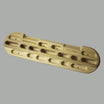
Beastmaker 2000 — A classic wooden hangboard offering unmatched hold variety for structured finger training.
The Beastmaker 2000 is widely regarded as a gold standard for hangboard training. Made from high-quality wood, it offers a comprehensive selection of edge depths, slopers, and pockets — all arranged in a clean, symmetrical layout.
This board is designed for climbers who follow structured training plans. The wooden texture is skin-friendly, making it suitable for repeat sessions, while the range of holds allows you to scale difficulty over time rather than outgrowing the board.
Best for: Intermediate to advanced climbers who want maximum hold variety and a proven training platform.
So iLL Split Palm — Adjustable, Shoulder-Friendly Training

So iLL Split Palm — Adjustable split design that promotes better shoulder alignment and joint-friendly hangs.
The So iLL Split Palm takes a different approach with its two-piece, modular design. By allowing you to adjust the spacing between the boards, it promotes better shoulder alignment and reduces unnecessary joint strain — especially during longer training blocks.
This design is particularly useful for climbers managing past injuries, asymmetries, or those who simply prefer a more natural arm position. It’s also ideal for home setups where flexibility and customization matter.
Best for: Climbers who value joint health, adjustable setups, and clean minimalist design.
So iLL Iron Palm 2.0 — Compact, Focused Power Training

So iLL Iron Palm 2.0 — Compact, high-intensity hangboard built for focused finger strength sessions.
The So iLL Iron Palm 2.0 is a compact, high-intensity hangboard designed for focused finger strength work. Built from durable synthetic material, it features aggressive edge options in a space-efficient footprint.
Because of its smaller size and sharper focus, the Iron Palm 2.0 is best used as a targeted training tool rather than a do-everything board. It’s ideal for climbers with limited wall space or those supplementing climbing with short, intense hang sessions.
Best for: Experienced climbers, limited-space setups, and high-intensity finger training.
Which Hangboard Should You Choose?
- Choose the Beastmaker 2000 if you want maximum variety and long-term progression.
- Choose the So iLL Split Palm if adjustability and joint-friendly positioning matter most.
- Choose the Iron Palm 2.0 if you want a compact, powerful board for focused sessions.
Common Hangboard Training Mistakes to Avoid
- Skipping warm-ups before hanging.
- Training too frequently without enough recovery.
- Jumping straight to small edges.
- Training through pain instead of stopping early.
Final Thoughts
Hangboards don’t replace climbing — they enhance it. Used intelligently, they allow you to train finger strength in a controlled, repeatable way that’s hard to achieve on the wall alone.
Visit Boulder Planet Showroom to see these hangboards in person, compare textures and sizes, and get advice on choosing the right board for your training goals in 2025.


Leave a comment
This site is protected by hCaptcha and the hCaptcha Privacy Policy and Terms of Service apply.